










1- Talking about feelings
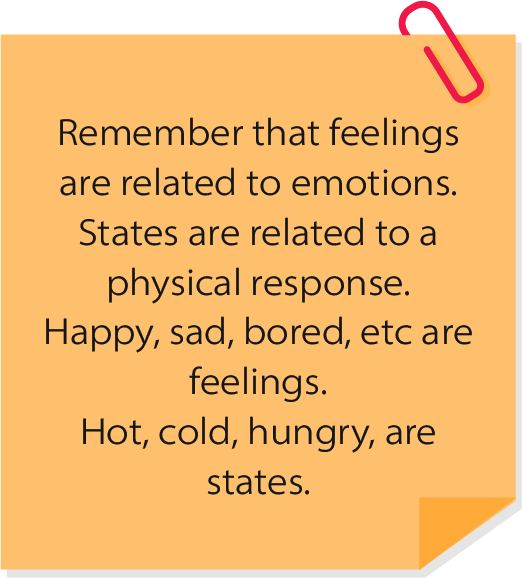
Many things influence the way we respond to life. To describe the way we feel, we use adjectives. These words help us describe our status in front of different situations.
Have a look at the chart below. It has some of the many words we use to describe feelings or states. Green refers to ‘standard’ descriptors and Red refers to "extreme" descriptors.
|
Happy |
Glad |
|
Sad |
Devastated |
|
Hungry |
Starving |
|
Bored |
Dreary |
|
Funny |
Hilarious |
|
Cold |
Freezing |
|
Old |
Ancient |
|
Good |
Terrific |
|
Ugly |
Hideous |
|
Pretty |
Gorgeus |
|
Bad |
Terrible |
|
Angry |
Furious |
So, we don’t say:
I am very happy, we say: I am glad.
She is a very good student, we say: She is a terrific student.
He feels very bad, we say: He feels terrible.
For expressing feelings or states, we can use the verb "be" or the verb "feel" as follows:
|
Be |
Feel |
|
I am pretty |
I feel pretty |
|
You are hilarious |
You feel devastated |
|
We are hilarious |
We feel bad |
|
They are gorgeous students |
They feel freezing in the rain |
|
He is bored in class |
He feels terrific today |
|
She is tired |
Mary feels dreary. She hates Math |
|
The dog is glad to see you |
The dog feels terrific after the visit to the vet |
We follow the same rules we have seen over and over when we describe our feelings or someone else’s feeling directly. But when we want to refer to someone else’s state indirectly, we use the article "a" or "an" before the descriptor, and after the verb "be" when the person we are describing is singular. That means we are describing "I" "you" "he" "she" or "it".
I am an excellent friend. I always help.
Mark is a terrific student. Only 7s in his report cards.
You are a hilarious friend, I’m happy to have you in my life.
This is an ancient painting by Picasso.
We don’t follow the same rules for plural subject. When we describe "we", "they", we don’t need articles a/an.
Those birds are hideous. They look like monsters!
My classmates and I are starving. There is a long line in the cafeteria.
Spanish corner
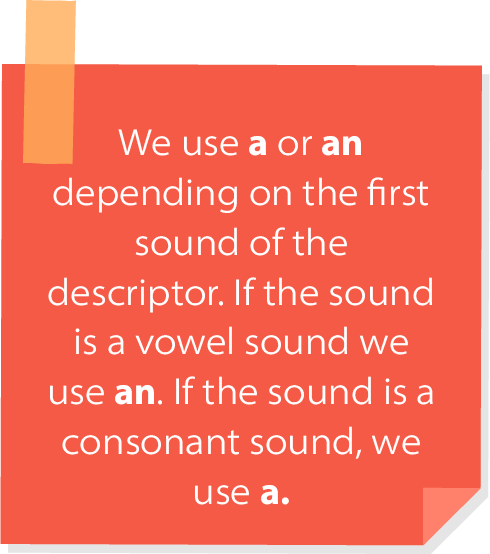
Usamos adjetivos para describir sentimientos y estados. Sentimientos se refieren a todo lo relacionado con tus emociones. Estados son respuestas físicas de nuestro cuerpo. Podemos utilizar el verbo ‘be’ en sus formas "am, is, are" para referirse a emociones o estados. Cuando lo utilizamos en describir a personas singulares necesitamos de los artículos ‘a/an’. Utilizamos "a" cuando el sonido que viene antes del descriptor es una consonante. Utilizamos ‘an’ cuando el sonido que viene antes del descriptor es una vocal. Por lo tanto:
Sujeto plural + are + descriptor + detalles
es la estructura para sujetos plurales
Sujeto singular + are/is/am + a/an + descriptor + detalles
es la estructura para sujetos singulares.
El verbo ‘feel’ también nos ayuda a expresar en este contexto, y para eso solo necesitamos considerar las reglas del presente simple como fueron vistas en la primera lección.
2- Why do we feel the way we feel? Explaining feelings
To explain reasons, we need a connector to help us structure our ideas. The most popular connector of cause and reason is "because" and its synonym "since".
Here are some examples.
I am exhausted, because I ran too much.
I am always hungry, because I don’t eat breakfast.
She is hilarious, because she always tells jokes.
My friends are terrific, because they always support me.
See? Giving reasons to support our ideas is great for developing more fluency and speak more English.
When using because, we only need a comma before this connector. Something different happens with "since". When we use "since" we don’t need a comma except when we start a sentence with it. We hardly ever use "because" to start a sentence.
I always feel exhausted since I run too much.
Since I run too much, I always feel exhausted.
I am always hungry since I don’t eat breakfast.
Since I don’t eat breakfast, I am always hungry.
What happens here is that we need to organize our "causes" and "effects".
Causes are situations that make you feel in a particular way ‘ effects’ are the results of that particular situation.
In
I am exhausted since I run too much.
The cause is "I run too much", and the consequence or effect is "I am exhausted".
In
She is hilarious, because she always tells jokes.
The cause is "She always tells jokes", and the consequence is "She is hilarious".
See? Connectors of reason always present the consequence or effect of a cause.
Spanish corner
Los conectores de "razón" pueden ser "because" y "since". Ambos presentan las consecuencias de un comportamiento, entonces se ubican antes de esta.
En el caso de "because" utilizamos comas, y siempre al medio de las oraciones. "Since" puede usarse al comienzo de una oración ubicando una coma (,) luego de la razón. Mientras que cuando se utiliza al medio de una oración, no son necesarias las comas.
Have a look at this conversation between Rose and Johanne. How do they talk about their feelings?


Rose: Hello, Johanne, how are you today?
Johanne: Hello, Rose, I’m not so good, I’m angry.
Rose: Hello, Johanne, why are you angry?
Johanne: I am angry, because I am horrible at Math. How do you feel about Math?
Rose: I see… I feel ok because I study every Tuesday with a private teacher. Is your mom happy with her new job?
Johanne: Yes, she is. She loves hospitals and food. She cooks a lot. How does your dad feel about your Math lessons?
Rose: He feels amazing! Mr. Tom is a terrific teacher, and he knows my dad very well. My dad loves him…. I’m freezing now!
Johanne: Sounds good. Why are you freezing?
Rose: It's cold outside.
Johanne: Go get a jacket before the break ends. Have a nice day. Bye.
From the conversation above, we see that we need:
Structures to ask questions about feelings
Phrases to express sympathy
To ask questions about feelings, you need to follow the following structures:
|
With the verb "be" |
For asking about the description of singular subjects (Question word) Am/is/are + subject + a/an + descriptor + details? Is Mr Tom a good teacher of Math? For asking about someones’ feelings (Question word) Am/is/are + subject + descriptor + details? Is your little sister happy with dance lessons? |
|
For asking about description of plural subjects Am/is/are + subject + descriptor + details Are your classmates happy kids? |
|
|
With the verb "feel" |
Here we use the rules of the present simple seen in past lessons: (Question Word) Do or Does + Subject + feel + details How does Annie feel about Math? |
Question words for talking about feelings:
Why we use this question word to know the reasons someone has to feel in a particular way:
Why are you sad?
How we use this question word to know the way someone feels in a particular situation or in a particular moment.
How are you today?
How do you feel about Math?