







1- Energies of the future
We know that there are many species at risk of extinction on our planet. This is why we need to find various and alternative type of energy. A popular term nowadays is “clean energy” which is closely related to “renewable energy”, the energy obtained from nature and its inexhaustible sources. A “clean energy” is the one that doesn’t pollute the environment with its waste. Therefore, we can say that clean energy is the energy of the future.
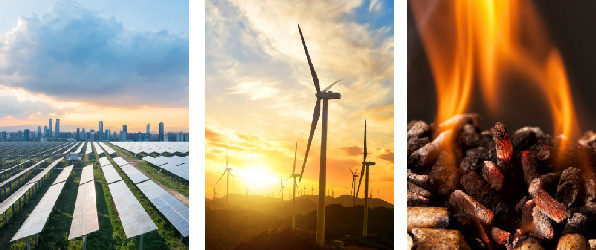
These are the main types of clean energy:
Solar energy
This energy, collected directly from the sun through solar panels, can be converted into heat, illumination, hot water, and electricity. This energy accounts for 1% of the world’s power, and its use is increasing every day around the world.
Wind energy
This energy can be considered as a type of solar energy because winds are caused by the differences in temperature on the Earth’s surface. It can be used to generate electricity, but to produce significant amounts of energy, a wide area needs to be covered.
Biomass energy
This is the energy obtained from any organic material coming from either plants or animals. It is widely used throughout the world, often burnt directly. It is also used to create biofuels such as ethanol or biodiesel for vehicles that use this type of energy.
Clean energies are often considered as hard to implement, but the world is more aware every day that if we don’t change the way we produce energy, we won’t save our planet, our only home.
2- Vocabulary and Prepositions.
Look at the highlighted words in the text: from and to These words are PREPOSITIONS
The word “preposition” means “positioned before”.
Prepositions are usually short words, commonly placed in front of nouns or pronouns.
Their function is to show the relationship of two or more nearby words.
Every preposition has different uses according to the context. Here are the most common uses of FROM and TO:
2.1- From
To express origin:
We use “from” to refer to a place where someday or something comes or goes.
Examples:
Alice comes from Ireland.
Everything we eat is from our own orchard.
That passage is from a Shakespeare’s play.
To express a starting point:
We use “from” to refer to a specific point in time when something starts.
Examples:
The final exam takes place from 10.00 am next Wednesday.
The library is opened from 8.00 am every day.
2.2- to
To express purpose:
We use “to” for indicating the purpose of something.
Examples:
That instrument is used to measure air pollution levels.
We tell our stories to inspire people.
To express destination:
We use “to” for indicating a destination or address.
Examples:
He is coming to the cinema with us.
I walked to the office.
She is on her way to the metro station.
To indicate the receiver of an action:
We use “to” for talking about a person or thing to which it is directed or receives something.
Examples:
He gave the letter to his girlfriend.
I’ll explain the situation to you later.
2.3- More cases
Many times these prepositions go together in the same sentence “From … To”. In these cases, the main purposes are:
To give directions
Example:
You need to walk from the corner to the next street.
To express the change of state of something
Example:
I have to translate this entire book from English to Spanish.
To express a period
Example:
He works from 9 am to 5 pm every day.